Executive Summary
I built a production-oriented cashflow intelligence system that turns fragmented spreadsheet-based finance inputs into a reliable, daily operational view. The solution ingests Excel data into SQL, runs a curated ETL pipeline, and powers Power BI dashboards for cash visibility. On top of the data foundation, it automates bank statement transaction auto-remark and provides low-balance risk detection with email alerting to Finance users.
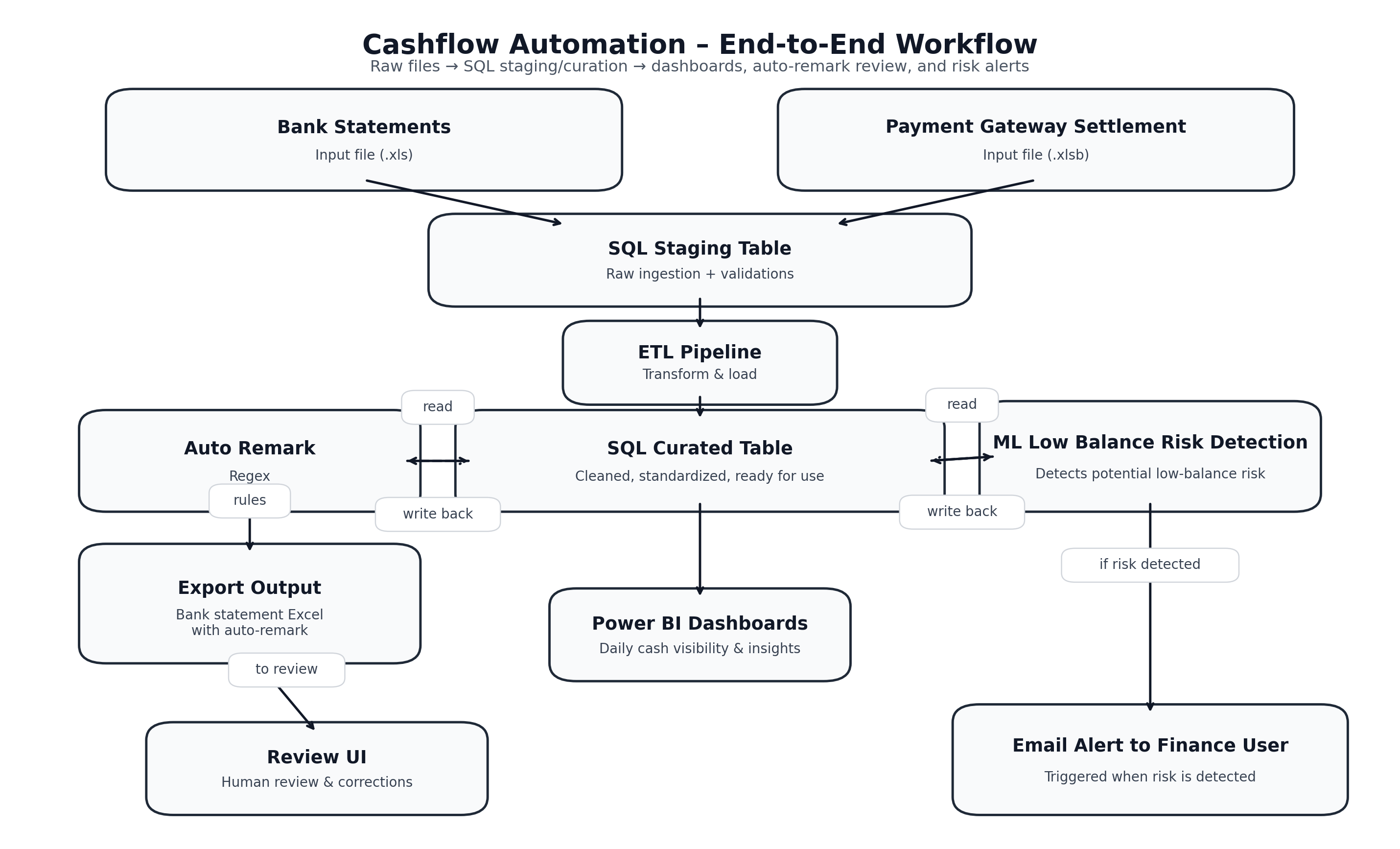
Before vs After
Before
- Manual consolidation across spreadsheets with inconsistent formats
- Slow reconciliation and high reliance on individual know-how
- Limited daily cash visibility for operations
- No consistent early-warning for low-balance situations
After
- Standardized SQL staging + curated tables as the source of truth
- Repeatable ETL pipeline supporting Power BI dashboards
- Auto-remark workflow with traceability and safe review points
- Low-balance risk detection with email alerts for timely action
What I Built
1) Data Ingestion (Excel → SQL)
- Validated inputs and standardized formats
- Loaded into SQL staging tables for controlled processing
- Created a reliable base for downstream joins and reporting
2) SQL ETL (Staging → Curated)
- Transformations into curated tables for consistency
- Data checks for completeness and anomalies
- Designed for maintainability and handover readiness
3) Power BI Dashboards + UI Review
- Daily cash visibility and drill-down views
- Reviewed dashboard usability (filters, navigation, clarity)
- Optimized to support Finance operations workflows
4) Auto-Remark for Bank Transactions
- Automated transaction remarking to reduce manual reconciliation
- Human-in-the-loop handling for uncertain cases
- Traceable decisions suitable for audit-minded stakeholders
5) ML-Assisted Low-Balance Risk Detection
- Detects low-balance risk situations early
- Designed for alert quality (cooldown / prioritization)
- Extensible for richer features and future improvements
6) Email Alerting to Finance Users
- Sends actionable alerts with context for next steps
- Supports operations with timely visibility
- Structured for safe, repeatable daily runs
End-to-End Flow
Ingest
Standardize Excel inputs and load into SQL staging with validation.
Curate
Transform staging data into curated tables for reporting and automation.
Visualize
Power BI dashboards provide daily cash visibility and operational drill-down.
Automate
Auto-remark reduces manual reconciliation while keeping safe review points.
Detect
Low-balance risk detection identifies early-warning signals for Finance teams.
Alert
Email alerts notify Finance users with context to drive timely actions.
Architecture at a Glance
Core Layers
- Input: Excel bank/finance files
- Data: SQL staging + curated tables
- Processing: ETL + automation scripts
- Analytics: Power BI datasets + dashboards
- Intelligence: auto-remark + risk detection module
- Notification: email alerts to Finance users
Design Principles
- Reliability: repeatable runs, observable logs
- Auditability: traceable decisions and outputs
- Human-in-the-loop: automation supports review
- Maintainability: modular pipeline for handover
- Extensibility: new sources, rules, and models
Outlook
This project establishes a scalable foundation for operational cashflow intelligence by integrating data engineering, automation, and applied machine learning into real Finance workflows.
With a standardized SQL-based data layer and modular ETL pipeline in place, the system can be extended across additional sources, reporting needs, and operational use cases without major redesign.
Future Enhancements
- Richer feature engineering using historical patterns and seasonality
- Adaptive risk thresholds informed by account behavior and cashflow trends
- Alert prioritization and escalation paths to reduce noise
- Tighter integration between dashboards and action workflows for Finance users
Most importantly, the solution is designed so that automation supports—rather than replaces—human decision-making, enabling trust, auditability, and long-term sustainability.
Want to Collaborate or Learn More?
If you’re building finance automation, operational dashboards, or ML-in-the-loop workflows, I’d love to connect and share what I learned.